Reading? Let’s Talk About Reading.

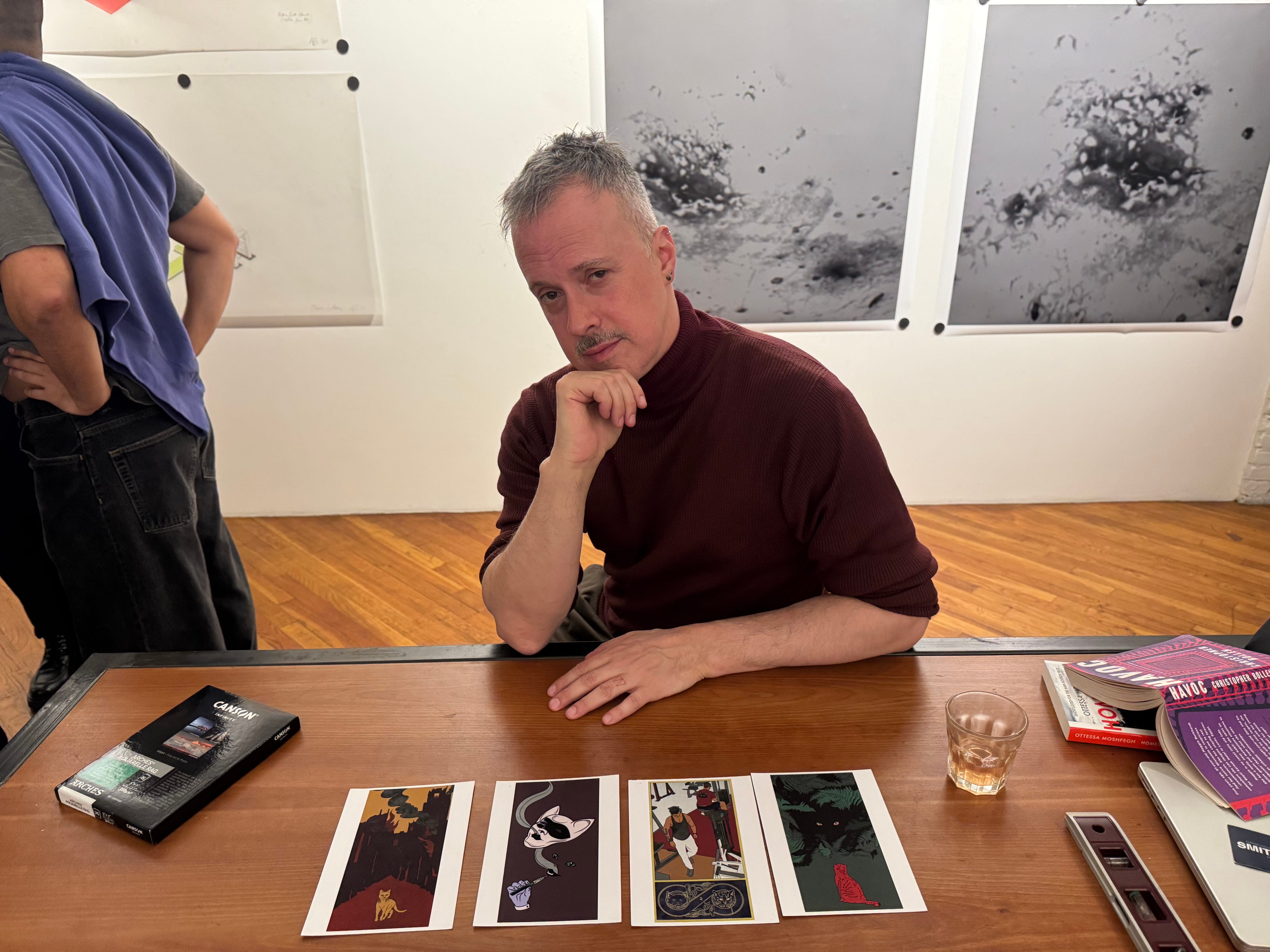
Throwing caution to the wind, I decided to respond to (not review) the latest exhibition Cat Suit by friends and comrades My Barbarian (Jade Gordon, Malik Gaines and Alexandro Segade) in New York’s Chinatown. Xandro, as they are known, is a talented and intuitive reader of the tarot, as well as an estimable contemporary artist in their own right. So I did not miss the chance to join others who got impromptu readings from one of the talented trio, as part of the opening performance.
Xandro explains by way of context:
Artist-mystics Nikki de Saint Phalle, Leonora Carrington, and Alejandro Jodorowsky reimagined the Major Arcana, the Tarot’s 22 trumps. My Barbarian (Malik Gaines, Jade Gordon, and Alexandro Segade) begin instead with the Minor Arcana, the more common, everyday experiences, most of our lives. Segade is designing a new deck that starts with a cat suit. Tarot and cats share a certain mystique, reflecting mysteries we project onto them.
I love this idea because I too am working at the moment with a concept of a minor that is a major (in my case interrogating the catchphrase “people of the global majority”). I also respond to this statement insofar as my work in affect theory marks the common, everyday, and ordinary as worthy of notice, study, care, and so forth.
Responding to an exhibit in the form of a card reading, to be sure,takes me off my guard as a critic, insofar as critical distance is not really possible when you are interacting with the artwork as an allegory of your own past, present, and future states. But what’s queerer than that? What follows is a condensed and lightly edited version of our reading-cum-conversation, in which I probably reveal more than I should about my inner state, and Xandro makes a plausible case that they may have an alternate career as a card reader.
Interview Transcript
(Tarot reading conducted with the deck Xandro is designing)
Tavia: The show connects surrealism, tarot, performance—what drew you, as My Barbarian, to the Tarot?
Xandro: We’ve been using tarot in our performances since the beginning. In our 2004 film Pagan Rites, there’s a long scene where Jade plays the leader of a commune and does a tarot reading that culminates in my character getting expelled. That was based on an experience her mother had in the ’60s. So from the start, tarot has been a kind of familial inheritance.
I also got my first deck at 13—the Tarot de Marseille—growing up in Southern California. We were always looking at where our personal lives and the wider world meet. When mysticism started showing up everywhere in our queer communities, we asked: how do we contribute—artistically and critically?
And if you go back to the Golden Dawn, they encouraged artists to make their own decks rather than buy one. That really stuck with me.
Tavia: I’m reading these days about magical thinking, and have had a witty friend even tell me “delulu is the solulu,” which hits as a zinger for me insofar as I have been called a magical thinker. And even though I’m not a regular tarot reader, I’ve had readings that were almost dangerous because I surrendered too much agency: Should I move? Should I keep my relationship or break up?
But as a surrealist image, the tarot really works. And what interests me now is how your Minor Arcana—literally “the minor” that is a majority of the deck—which resonates with minoritarian aesthetics. It’s the theme of the next Venice Biennial — “In Minor Keys,” (a theme set by the late and must missed Koyo Kuouh before her untimely passing).
Meanwhile in your deck, we’re all cats…
Xandro: Yes, cats and frogs. Let’s do a reading about how you approach art—how you find threads that let you tell a story of the contemporary.
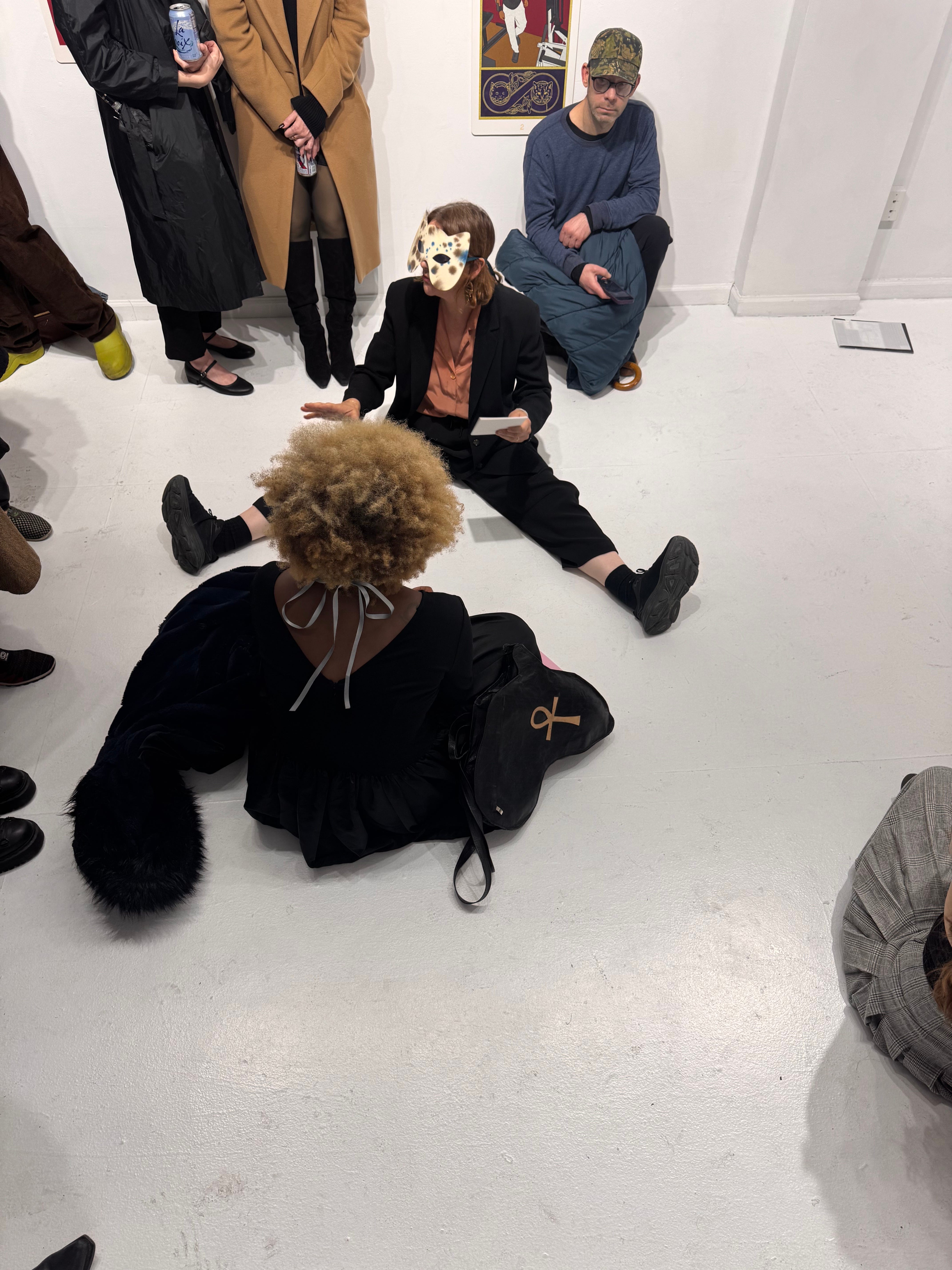
THE READING
Card 1 – The Situation
Xandro: The 11th card of the Minor Arcana—Youth. It’s about survival amid chaos and destruction, hope in hopelessness. It’s generational, but also something inside each of us. We’re living through collapse, but we’re also looking toward new guides, new energies.
Tavia: A little feral, maybe.
Xandro: Exactly. Feral wisdom.
Card 2 – You
Xandro: The Ace. This card is about choosing. Anything is possible, but you must select an identity, a path. Jodorowsky says: at this point, anything can still happen.
Card 3 – The Collective / Environment
Xandro: The Two. Preparation. You’ve already committed to something—maybe without fully acknowledging it. The image is two cats at the gym.
Tavia: My first thought is literally: I need to get back to the gym. True, but maybe too literal. What else could the two of cats mean?
Xandro: It’s discipline across any medium. The original Marseille card links to the High Priestess—gestation, writing. If you’ve done something long enough—lifting, writing, painting—you’re no longer a beginner. You’re deepening a commitment.
Tavia: That makes sense. What I’m really doing these days — in addition to teaching, writing, and curating — is drawing and painting. I share a sliver of this visual art publicly, but most of it is private experiment or something I share with friends through the mail. And that raises the art-world question: how do we move from individual silos—artist, curator, scholar—into something collective again? My Barbarian did that early on. You and Malik were the first New York people to say to me, “Come sing at Artist Space as a chorus of artists and arts professionals.” Then you go home, do the work, and come back changed.
Xandro: Yes. And notice: you pulled one late-cycle card and two early-cycle cards. You’re between What should I be? and I’m preparing to show it, but not yet It’s public.
Card 4 – What You Must Consider
Xandro: The Ancestor. Final card of the series. It’s both a return and a responsibility.
Tavia: As a Halfrican, gay, homosexual person, whatever, I bring real ancestors with me—not just chosen ones. Queer culture often talks about chosen ancestors, but mine are also literal. And I also get to wonder what kind of ancestor I will be. How do I honor my lineage without reproducing patriarchy? I don’t have children, but I teach. I mentor. I’m still in relation to the next generation.
Xandro: And look—your first card was Youth. Your last is Ancestor. You’re on that bridge. When you bring your art into the world—even one painting in a gallery—you enter the lineage. You stop asking “Who should I be?” and start being someone future artists read through their cards.
AFTER THE READING
Tavia: One final question: how have readings gone for others today?
Xandro: Surprisingly emotional. I take tarot seriously—strangely, the decks are mostly made by playing-card companies! But when you sit down with someone, you’re talking about their life.
One Parsons student pulled the adult card and just said, “I need to grow up”—and cried. Another person needed hope, and the Youth card gave it to her.
I think of it like Jodorowsky says: the Tarot reflects the life cycle. We’re always in all of these stages. The reading just focuses the conversation. I joke that it’s Brechtian—I’m materialist, I’m procedural—but something in the fantasy, in the images, resonates. I feel a responsibility. A Spider-Man moment: with great power… etc.
Tavia: Thank you, Xandro. I’ll be thinking about this reading—and your new show—for a long time.
Xandro: My pleasure.
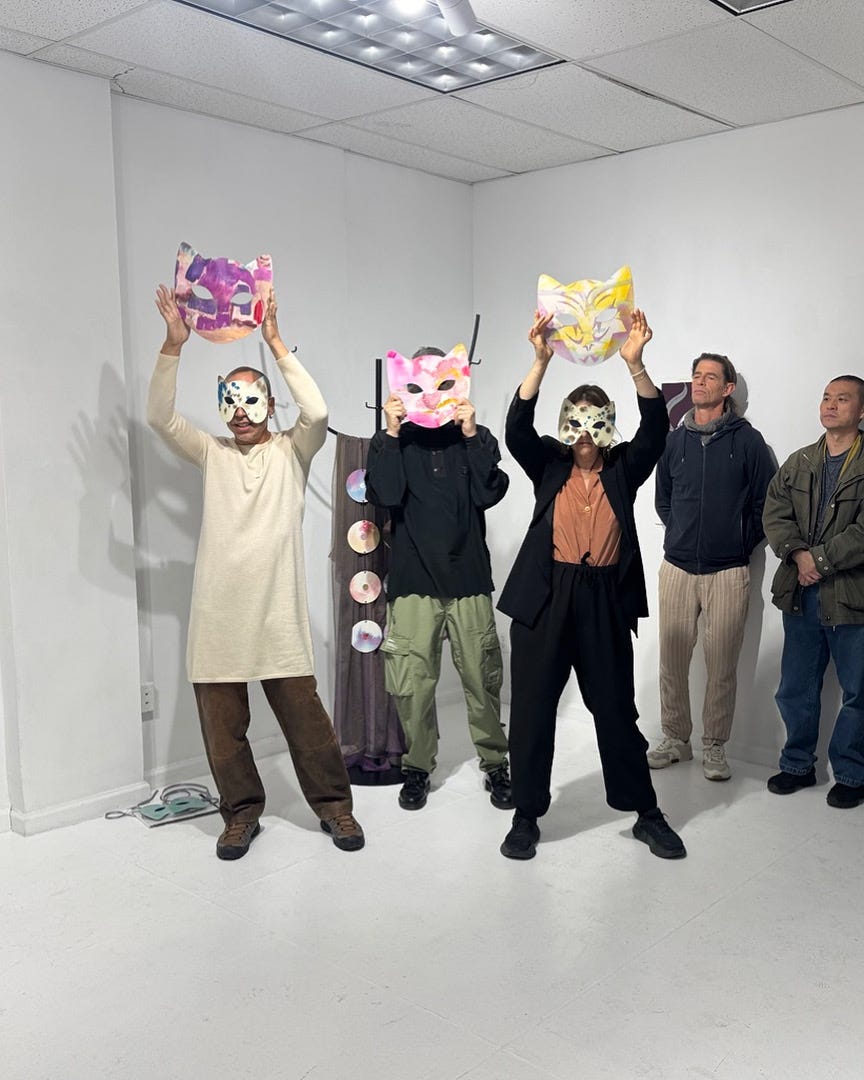
Cat Suit, by My Barbarian, on view at Lubov Gallery, 5 East Broadway, 4th floor, Nov 15, 2025 — Jan 17, 2026