The Exhibit as Third: A Conversation with Sam Penn and Max Battle

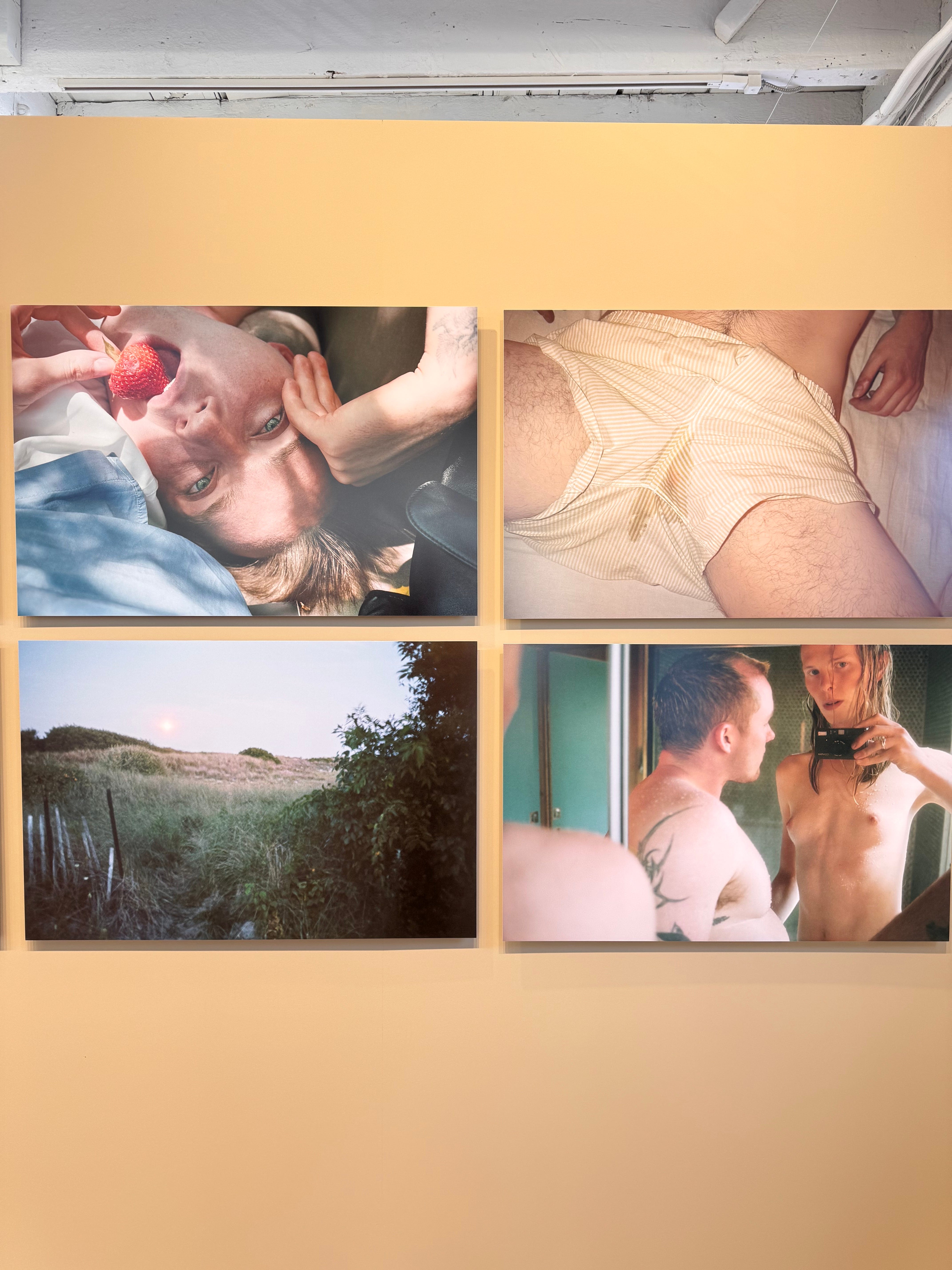
This post is going up a bit later than I’d hoped, but I didn’t want to close out the year without posting this interview I was generously granted with the duo behind one of the most memorable shows I saw this fall season: “Max” by Sam Penn at New York Life Gallery. Sam Penn is a New York-based photographer whose work has been exhibited at Galerie Balice Hertling in Paris and OCDChinatown in New York, and featured in magazines such as Interview, Cultured, Dazed, Document Journal, and AnOther Magazine. Prior to “Max,” her recent exhibitions include “Some Girls” (2023), and “Bad Behavior” (2024). Working in the diaristic tradition of Nan Goldin — or Andy Warhol polaroids — Penn photographs her close circle—including subjects like actor Hari Nef and artist Ser Serpas—creating work that explores intimacy, desire, and the social construction of looking. For “Max,” she collaborated with her partner the writer Max Battle, who wrote the startling text to the book accompanying the show. At a moment when trans lives are under public scrutiny and assault, it feels at once vulnerable and confrontational to invite the viewer into the heat and glamour of an international love affair. Without further ado, here is out conversation via email:
TN. Weirdly, my first attempt at sending these questions went into the ether, so I am reconstructing them from memory. Let me start by saying I love the show and the little chapbook “Max” that I could not resist taking home a copy of. So I guess you could say it stuck with me! Reading Max’s text, from which I quoted in my first version of this, drove home for me collaborative this show is. As I recall, my first question for you two had something to with what it feels like to invite the gallery viewer into these intimate moments, to view these photographs that appear as if plucked from a different category altogether than public or private.
Hi Tavia, Sam and I are sitting in my Chinatown apartment, it’s 3:50 on a Monday, she’s like totally burnt out after months of touring and interviews etc, lucky girl, and given that I’m the writer in the room I’m going to answer these thoughtful and fun questions and she will chime in, hope that works!
I think it’s hard to articulate what it feels like to do something like this, I just keep saying I feel alive. Sam says it’s nerve-wracking, mostly for the big photo of her, she’s never shown anything this explicit before though she’s had practice showing other subjects in similar positions. She says it was really exciting for her though, because it allowed her to empathize with my experience which felt important and necessary in order to make this show, for us to get on each others levels in as many ways as we could.
We like this idea that the photographs feel plucked from a space other than public and private, there is definitely an element of performance in many of the pictures. While we were shooting this summer, we knew that the photos might end up in a kind of transgressive public show. Of course, they are also coming from a place of genuine attraction, we shoot for ourselves all the time, so for a while it wasn’t totally clear what we were doing for an audience and what was just for each other. We were turned on either way. Sex can be really playful and performative and fun, it’s a creative act, inherently, so it was nice to really lean into that. The show has become a part of the relationship. It’s always complicated to have a third, but it keeps things exciting.
TN. The idea of the exhibit as a third in the relationship makes so much sense for how this show lands in the space. My second question was about the vibe of the show and of that gallery in particular, which seems to carry a certain frisson in the art/fashion/club continuum. Sam you have shot rock stars like Lorde, and these images have a languid look that works beautifully at the scale and saturation of the prints. What was it like to use this lens to tell your own story? (Optical tricks like your use of mirror selfies is one way I imagine.
Sam is thinking. We are talking. She says, “Everything starts with my personal work. I was showing in galleries and making prints of my friends and lovers before I did anything commercial in fashion or music, so it does feel like the life force of everything and the arena where I can make stuff on my own terms. It also informs how I shoot commercially, the biggest thing I try to focus on in any setting is connection and understanding from a subject. I try to take photographs that reflect or show an honest part of the person I am shooting.”
When this whole thing started, you repeated something along the lines of “this show is about you (Max) but also mostly it is about me (Sam),” which I slightly resented but also totally understood, because of course, most art is about some level of self-interrogation. I think the question is maybe asking something about that.
“I’ve always wanted to do a show focusing on one other person, mostly to see if I could use a relationship as a self-portrait. The show is all about Max, sure, but it’s also about me. I guess, actually, it’s about us, and what we can make together. “
The show has become about us and what we can make together through necessity, because I wouldn’t let you use me for her own self-investigation unless you were interested in letting me use you in return.
Sam: “Yes totally. Initially, I was interested in doing a show focused on sex and trying to get to this place of deep intimacy to be able to show nudity in a beautiful and shameless way. I’ve tried to do this in the past with people who I am close with, because that is how you get a good photo, you need someone to be comfortable with you. I’d already been shooting Max this way, and when we were talking about the possibility of this show and how it could feel ok for me to use him for this, he proposed that maybe he would write something, and this instantly felt like an incredible idea and a way to balance things out. It allowed us to go to this really exposed and vulnerable place that we could not have gotten to without the other person. So now it’s been really exciting to see that this is all really only possible with each other.”
I think this is what the kind of deep intimacy you were after looks like; it requires trust and mutuality. The writing opened the door for collaboration; I think it helped you see that you could trust me too, my taste and all that, and then that trust began to shape the work itself. Do you want to talk about the formal qualities?
“I have always taken self-portraits with the camera in my hands pointed back at me or into a mirror. I’ve included these in zines and past shows. It was fun to involve another person, Max, in these self portraits this time around. I didn’t want to overcomplicate the practice by using a self-timer or anything; everything is really about letting things unfold naturally, feeling connected, and expanding on my past work. There is also a lot of repetition in the show; we shoot in mirrors a lot and there are several pictures of us kissing and lots of eye contact with the camera. It was cool to repeat shots in different settings to catch different tones of the relationship.”
I feel like there is so much in the repetition. We are both interested in sharing something honest, and using simplicity to figure out what that is. It’s great because we can do the same thing that we love to do over and over again, and every time it is a little different.
Sam: “Yeah, it’s really about relying on setting, place, mood, time of day, things that are pre-existing and then intervening in one simple way.”
TN. Max the line I had quoted before: “My body; the wall; her name. I ask for a voice and though her assent is enthusiastic, I still find her commitment difficult to believe. Sudden vertigo when I realize I won’t know how it’s worked until I’m up five flights, in the gallery, bound in the proof and surrounded.” I love the vulnerability and concision in these lines, and I had wanted to ask you before: do you still have that vertigo?
Yes totally. It’s a pretty intense exercise in letting go of control, or maybe it’s more accurate to say finding the right amount of tension, knowing when to push back and when to give in. I’ve had to learn how to advocate for myself actively to get to a place where it feels possible to share these photographs publicly without feeling ashamed. I can be quite passive-aggressive, so I think being forced to access actual aggression has been quite transformative—the stakes were too high to perform petulance or get in my own way.
A lot of it has to do with maintaining a sense of agency and authorship, and insisting on having my role in creating the work made explicit. There are photos that are truly spontaneous, photos that are all Sam in their vision, direction and execution, but there are also photos that I directed. I’d be alone in my apartment, and I’d put on my white hanes and start texting her pics, trying to turn her on, get her excited, entice her to come over, and when I had a good idea, she’d show up and shoot it on her contax. It’s new to feel such an intense need to articulate my contribution to a project, but asserting my agency, repeatedly, has been essential to making this feel like a collaboration and not a violent commodification, which photography often risks. The vertigo comes back whenever I’m faced with the reality that no matter how much effort Sam and I put in to complicating the idea of authorship, there will always be people who miss it, or don’t think deeply or look closely, but that’s what I signed up for, and I believe in the work so it’s worth the discomfort.
TN. Another line from the chapbook: “Name a single person we love who doesn’t like sucking cock” caught me up short, next to unforgettable that photo which also serves as the hero image. Here text and image hail a community of desire that upsets the entire apple cart of trans and queer identities we have so elaborately set up. But what is my question though? Why can’t things be as simple as we need them to be?
… I have more questions about the range in the show: skylines, landscapes and beaches that set up the almost diaristic shots …
Right? That line could of course be challenged and litigated, but I found it compelling when I was writing and thinking about the discomfort I was feeling. Sam had shared the show with a publicist early on this summer, and she, apparently, slammed her laptop shut when she saw it. This wasn’t the show she expected from Sam. Sam was super cool about it, but it freaked me out. I started worrying that I was pushing her practice in an unpalatable direction, even though she was constantly reminding me that this kind of show is something she has wanted to do for years.
And yeah, what is a cock, really… I guess that was part of the point for me, too. Does it make a difference that the one in question is not flesh and blood, would it be more salacious if it was? I don’t really know, but I started thinking like, hey, cocksucking, the enjoyment of it, this is something that really ties together all the people I love across identity lines. I do have friends who would probably argue they don’t fit the category, but I’d say they probably just haven’t found the right girl. Desire is so mutable.
I’m glad you brought up the trompe l’oeil of that image. It bespeaks the mutability of desire, as you say, but also the lure of the visible: that persistent fantasy that we can see and therefore know desire, when really the photograph keeps insisting on its own opacity, its refusal to settle into legible categories. How do you think about this tension between revelation and withholding in the work? Is there something about the photographic medium itself that amplifies or complicates what the show says, or shows, about trans embodiment and desire?
It’s a good question and a difficult one. Instability (of desire, bodies, power, intimacy) is fundamental to the work. We’re both trying to capture desire in our respective mediums—what it feels like to love someone, to want them, to have them for a moment. We are constantly changing how we perform for each other, re-inventing ways of relating to escape being pinned down; it’s a little bit like wrestling. I think that’s life? We are all unstable and constantly changing, and there is vital tension in approaching others with curiosity about what every new interaction reveals.
Photography is a remarkable medium because a photograph looks real, like it has been plucked from life. Many people rely heavily on their visual sense to understand the world, which makes it easy to see a photograph and forget that it is a fraction of the story. That said, the moment in the image undeniably happened, the body on the wall in the photographs did exist; her lips were wrapped around my dick, we kissed on the beach, the sky was grey in midtown. The combination of some visual reality, and the weight that we give to what we see, can make a photo feel like a tell all, though you can’t smell her Celine perfume, you can’t hear tense words or laughter, and it’s unclear if the way our bodies are configured happens as a natural part of our intercourse or was constructed to create an image.
The scale of the show, and the decision to hang non-linearly, and with the two large prints facing each other, emphasizes this sense that the viewer is stepping into the emotional landscape of the relationship. The landscapes play an important role in this as well, I think they create a dreamlike fluidity to the show, insisting on the natural, and illustrating this contrast between softness and hardness in the natural world too.
By destabilizing the language being used to talk about bodies, and by letting objects stand in as body parts, I think the show is asking us to think about embodiment holistically, as a kind of fullness, desire that wants power and control and submission and openness and connection all at once.
TN: Thank you for this candid and thoughtful answers, that have me thinking even more about the show and text. Looking forward to what you both do next.
Max by Sam Penn was up at New York Life Gallery from Nov 6-Dec 20, 2025.